
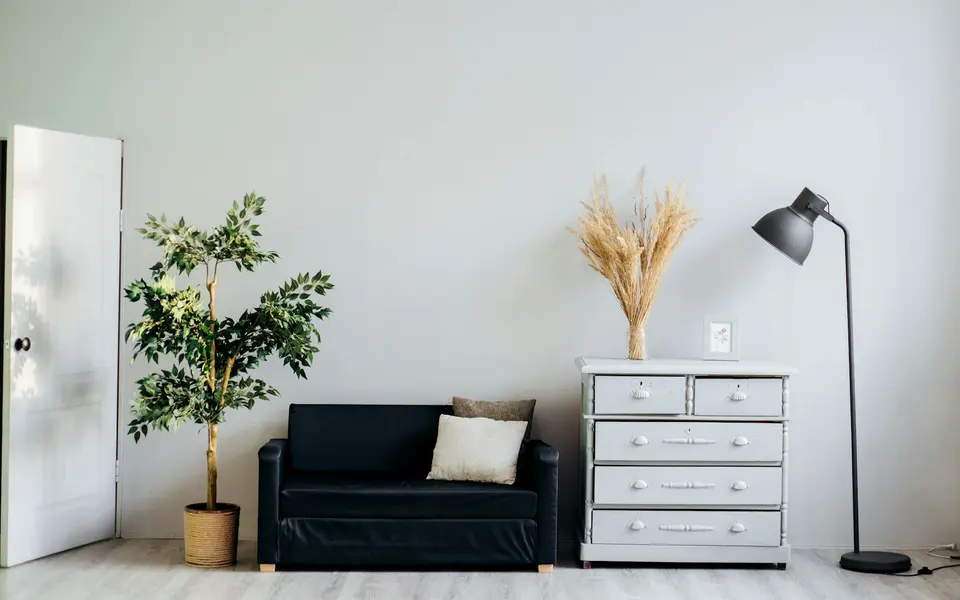
People notice good lighting before they can name it. The room feels softer, faces look better, and the corners stop disappearing. The difference is rarely a new fixture; it is the number of layers and where they sit.
Three layers, one room
Ambient light is the general wash that lets you move safely. Task light is brighter and focused: a reading lamp, a kitchen worktop, a mirror. Accent light is decorative: a picture light, a shelf glow, a low lamp in a corner.
A room with only ambient light feels flat. Add one task and one accent layer and it immediately gains depth.
Temperature matters more than wattage
Warm light around 2700K suits living rooms and bedrooms. Neutral 3000K works well in kitchens and bathrooms. Cooler light above 4000K belongs in workshops and utility areas, not above a sofa. Keep temperatures consistent within a room; mixed whites look accidental.
Put light where the work happens
- Reading: a lamp behind the shoulder, not in front of the face.
- Kitchen: under-cabinet light for the worktop, ceiling light for the floor.
- Mirror: light on both sides of the face, or a diffused bar above.
- Stairs: low-level light at each step, shielded from the eye.
Dim everything you can
A dimmer turns one light into several. Choose dimmable bulbs and a dimmer rated for them; not all LEDs dim smoothly. If a circuit cannot be dimmed, use a smart plug or a floor lamp with its own control.
Quick upgrades that work
- Replace cool bulbs with warm 2700K versions.
- Add one floor lamp to the darkest corner.
- Put the ceiling light on a dimmer.
- Add a small lamp on a sideboard or shelf.
- Shield any bulb you can see directly.